Alberti, M. (2026). Cities for a Shared Planet. The MIT Press.
View Publication
Abstract
A powerful new vision of cities as engines of planetary evolution and multispecies cooperation.
Evolution, once associated with remote places and deep time, is unfolding in real time, much closer to home. Cities have become a new ecological stage on which evolution is taking place. Humans are now active participants shaping the trajectory of life on Earth. How can we use this knowledge to build more resilient and just futures for humans and other species?
In Cities for a Shared Planet, Marina Alberti envisions evolving urban ecosystems in which humans and other species shape their shared futures through new forms of cooperation. She argues that the convergence of rapid urbanization and accelerating environmental change may mark the onset of a major evolutionary transition—one that redefines the role of cities in planetary evolution. At the heart of this transformation is the emergence of bio-cooperative cities: adaptive, multispecies systems designed to sustain the evolutionary potential of urban life.
Drawing on urban ecology, evolutionary biology, design theory, and environmental justice, Alberti develops the foundations of bio-cooperation, advancing ecological interdependence and eco-evolutionary dynamics as core principles of urban design. Through imaginative scenarios and real-world case studies—from Singapore, Seattle, New York City, Ho Chi Minh City, and Cape Town—the book shows how multispecies interactions are transforming infrastructure, reshaping urban space, and redefining how urban environments are inhabited and evolve.
Engaging and eye-opening, Cities for a Shared Planet reimagines cities as active participants in a shared planetary future.
Kenney, M. A., Kopp, R. E., Samaras, C., et al. (2026). Research priorities for robust climate assessments in the United States. Earth’s Future, 14, e2025EF007336. https://doi.org/10.1029/2025EF007336 Kenney, M. A., Kopp, R. E., Samaras, C., et al. (2026). Research priorities for robust climate assessments in the United States. Bulletin of the American Meteorological Society. https://doi.org/10.1175/BAMS-D-26-0305.1
View Publication
Abstract
Scientific assessments play a critical role in synthesizing evidence to support evidence-based decision-making in many sectors and topics. For climate change, large-scale assessments like the Intergovernmental Panel on Climate Change (IPCC) and the United States (U.S.) National Climate Assessment (NCA) reports help many different users—from national government to local governments, Indigenous Peoples and communities, the private sector, the social sector, and the scientific community itself—navigate the complex field of climate risks, impacts, and integrated solutions. While co-creation with users is essential to developing actionable assessments, this paper lays the groundwork for future processes by identifying many advancing and emerging areas of relevant knowledge ready for assessment or additional near-term research. Drawing on the expertise of many scholars who were formerly tasked with producing the Sixth NCA and authors of other national or sub-national climate assessment reports, this paper highlights select U.S.-relevant topics in which research advances since the 2023 Fifth NCA make new syntheses particularly valuable for future national, sub-national, and sectoral climate assessments. It also identifies critical research topics in those select areas that would be useful for future climate assessment efforts. Overall, this research priorities roadmap aims to catalyze collaborations, research, and a network of climate assessments to synthesize the state of climate impacts, risks, and responses and to provide widely accessible and foundational information for sectoral, regional, and cross-cutting climate action plans and decisions in the U.S.
Ashour, L., & Shen, Q. (2025). Unveiling post-pandemic commute choices amidst the rise of telework. Transportation Research. Part D, Transport and Environment, 149, Article 105068. https://doi.org/10.1016/j.trd.2025.105068
View Publication
Abstract
The post-pandemic “new normal” is characterized by increased adoption of telework and a decline in transit use, with a growing uncertainty about the long-term effects of these trends. This study investigates the impact of telework adoption on commute mode choice and the factors influencing individual preferences in the new normal, using data from the 2022 Seattle Commute Survey, capturing mode choice on each day in a typical workweek, providing a mixture of modes and the frequency of use for each respondent. Using the Multiple Discrete-Continuous Extreme Value (MDCEV), the study provides timely insights into the factors influencing commute mode choice, highlighting the significant influence of sociodemographic, job-related, and built environment characteristics on mode choice and the nuanced difference between modes, raising concerns about potential inequities in the new normal. The findings highlight the need to prioritize access to public transit, adapt transportation infrastructure to telework, and address rising inequities.
Sa, H., & Shen, Q. (2026). Understanding employees’ residential choices in connection to remote work during the COVID-19 pandemic. Cities, 173, Article 107008. https://doi.org/10.1016/j.cities.2026.107008.
View Publication
Abstract
The outbreak of COVID-19 resulted in the proliferation of work-from-home (WFH) and flexible work arrangements. Existing studies have not systematically investigated the resulting patterns of employees' residential choices within the metropolitan area. This study aims to deepen the understanding of employees' residential location choices during the COVID-19 pandemic by examining the impacts of their remote work status. The study is based on the 2022 Seattle Commute Survey, which collected information on work arrangements, individuals' sociodemographic characteristics, work and home locations, and commute and non-commute travel. The primary results of our analysis indicated that: (1) relocated employees who worked remotely (full WFH and hybrid) were more inclined to move outward from their work locations, compared to those engaged in in-person work, (2) employees relocating closer had the shortest commute distances across all work arrangements, while those relocating farther experienced the longest commutes, especially among full WFH employees, (3) remote work status (full WFH and hybrid) had a strong positive association with the choices of staying in original homes and relocating farther from worksites compared to the reference choice of relocating closer to worksites, (4) the influences of full WFH and hybrid work arrangements on the choice of staying in the original housing and relocating farther did not generally differ across age or household income groups, and (5) residential decisions were jointly shaped by a combination of work policy, sociodemographic elements, household lifecycle stage, commuting characteristics, and neighborhood attributes. Our findings contribute to the literature on employees' intra-metropolitan residential choices in connection with teleworking.
Keywords
Residential choices; Remote work; COVID-19 pandemic; Bayesian multilevel multinomial logistic model; Urban transportation planning
Ling, C., Chen, P., Chu, Y.-C., & Shen, Q. (2026). Not all teleworkers reduce travel: An intensity-dependent behavioral framework with explainable machine learning. Transport Policy, 187, Article 104267. https://doi.org/10.1016/j.tranpol.2026.104267
View Publication
Abstract
Previous studies have yielded mixed findings on the relationship between teleworking and travel, possibly due to overlooking teleworking intensity and its evolving impacts. This study examines how teleworking is associated with overall vehicle miles traveled (VMT) and vehicle travel time (VTT) across a spectrum of intensities, measured by the number of remote-work days per week. Using travel survey data in the Puget Sound Region, Washington, we estimate four explainable machine learning models (XGBoost with SHAP) that incorporate behavioral, socio-demographic, and built-environmental characteristics. Results find an intensity-dependent relationship among typical workers. Low-intensity teleworking (1 day/week) is associated with increased travel both pre- and post-pandemic, while moderate teleworking (2 days/week) shows near-neutral or marginally positive associations. In contrast, regular teleworking (3–5 days/week) is correlated with reduced travel. In 2023, teleworking intensity ranks among the top six contributors, accounting for 6.84% and 4.08% of model explainability for VMT and VTT, respectively, higher than in 2017. The reductions scale with intensity. Holding other factors constant, high-frequency teleworkers (3 days/week) in 2023 accrued approximately 10 fewer miles and 3 fewer minutes per five-day workweek than fully on-site workers, whereas full teleworkers (5 days/week) saved 19 fewer miles and 23 fewer minutes. These impacts are concentrated among high-frequency teleworkers with longer commute distances, while the effects are mixed among shorter-distance commuters. Teleworking can moderate impacts of other factors, such as commute distance, income, and population density. These findings help reconcile prior inconsistencies, showing that teleworking's role depends on intensity rather than simple adoption.
B. Xue, J. Zhang, B. Liu, M. Alberti, Y. Fan, D. Zhao, & N.B. Grimm, Accessibility–equality dynamics in urban blue and green spaces reshape human well-being, Proc. Natl. Acad. Sci. U.S.A. 123 (22) e2535714123, https://doi.org/10.1073/pnas.2535714123 (2026).
View Publication
Abstract
As urbanization accelerates, urban blue and green spaces are increasingly recognized as critical nature-based solutions for enhancing human well-being, delivering climate, environmental, and psychological benefits. Yet, the mechanisms by which access to these natural spaces and the equality of access by urbanites in diverse residential locations shape well-being remain poorly understood in the context of sustainable urban governance. Here, we systematically evaluated the spatiotemporal dynamics of urban blue and green space accessibility and equality across 279 Chinese cities from 2000–2100 and assessed their combined effects on well-being. We found that accessibility has a significant positive influence on well-being but follows an inverted-U-shaped pattern with distinct optimal thresholds. By contrast, equality shows a consistent, positive linear relationship with well-being. Although future accessibility is projected to improve, persistently high disparities among different segments of urban populations highlight the urgent need for equity-centered governance of blue and green spaces in cities. This perspective extends current approaches to environmental justice while revealing a structural mismatch between resource abundance and equitable distribution. To address this mismatch, we propose a prioritization framework that emphasizes context-specific, spatially targeted interventions, guided by four key drivers: the natural space to built-up area ratio, urban population size, the proportion of natural spaces with high accessibility, and urban landscape connectivity. By operationalizing these insights in an online toolkit for local governments, this work advances the fields of sustainable urban governance and equitable environmental planning.
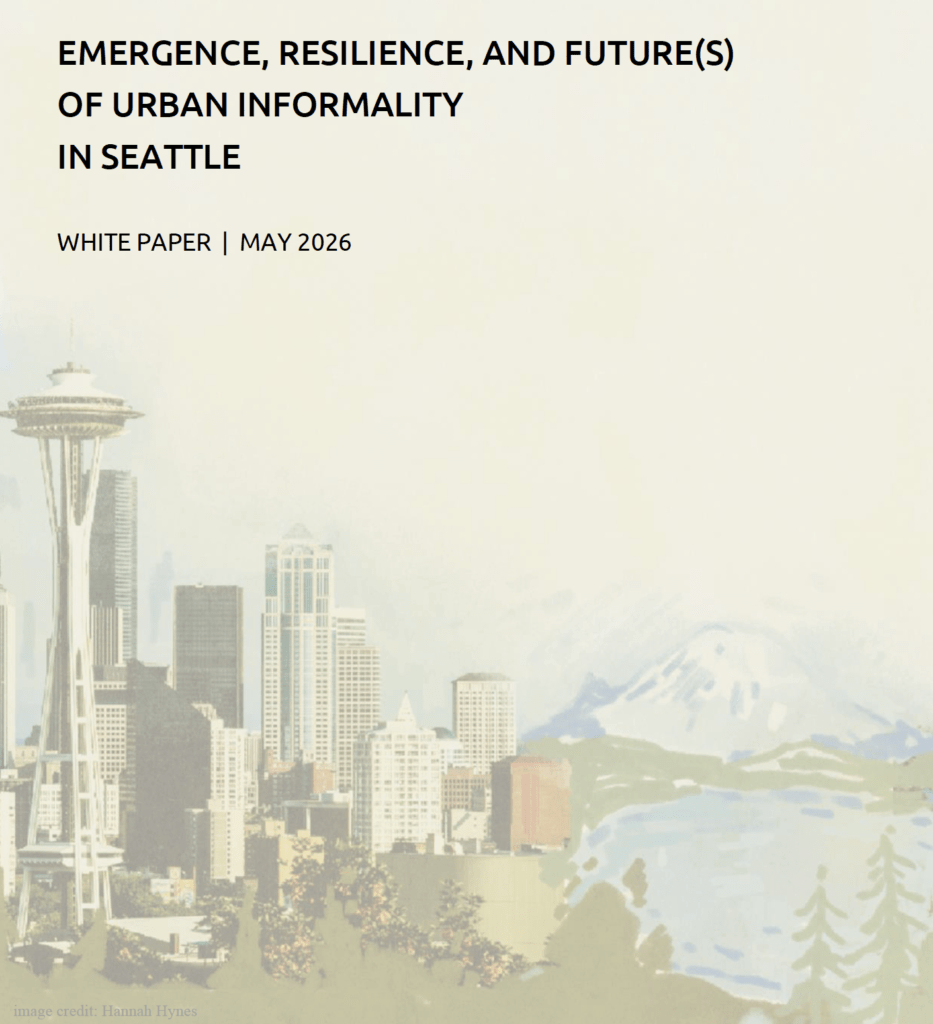
Chalana, M., & Johnson, J. (21 May 2026). Emergence, Resilience, and Future(s) of Urban Informality in Seattle [White paper]. College of Built Environments. Emergence Resilience Futures Urban Informality Seattle-Chalana-Johnson-21May2026

Professor of Urban Design and Planning Marina Alberti has recently published a paper in Science, and been featured in a UW News story highlighting her work along with a large team of collaborative researchers. UDP PhD Student Anna Malesis-Dahm is another member of this research team who supported the the writing and conceptualization of the article published in Science. UW News featured Professor Alberti’s work in a Q&A piece, available here. The paper, “Evolving nature-based solutions for urban resilience” can…
Marina Alberti et al., Evolving nature-based solutions for urban resilience. Science 392, 701-708 (2026). DOI: 10.1126/science.aea9563.
View Publication
Abstract
Despite growing investments in nature-based solutions for urban resilience, their design often overlooks a fundamental biological process: evolution. Populations of organisms that sustain nature-based solutions are dynamic and can evolve over time. Rapid evolutionary changes, driven by urban environmental stressors, such as pollution, climate extremes, and habitat fragmentation, can reshape species’ traits, alter interactions, and shift ecosystem functions. We synthesize evidence of evolutionary change across systems that serve as nature-based solutions in urban contexts and show how evolutionary processes can enhance or undermine their performance. We propose four testable hypotheses linking evolutionary dynamics to nature-based solutions and outline design strategies to maintain adaptive potential. Integrating evolution into nature-based solutions is essential to ensure long-term and efficient functionality under accelerating environmental change.
The College of Built Environments hosted a two-day research showcase and PhD symposium honoring Anne Vernez Moudon’s legacy, bringing together students, faculty and industry leaders to reflect on her impact and highlight current research across urban design, mobility and public health.